.png)




.png)


Decentralised solutions for a sustainable future

Key Challenges
Climate change is intensifying droughts, floods, and water scarcity, putting pressure on communities, ecosystems, and economies—especially in regions like the Mediterranean and Southern Africa.
At the same time, urbanisation is accelerating: by 2050, nearly 80% of the world’s population will live in cities. This increases the demand for flexible water systems, while rural areas face depopulation and reduced access to services. Traditional centralised water systems are not always affordable, efficient, or adaptable to these new realities.
Decentralised Water Management (DWM) solutions—such as wetlands, biofilters, green roofs, rainwater harvesting, and nature-based systems—can treat and reuse water locally.
Our mission & key objectives
%20(1).jpg)
WATERSENS aims to accelerate the shift towards resilient, decentralised, and sustainable water systems across Europe and beyond.
We aim to:
1. Provide a decision-making framework and develop tools to help water authorities, municipalities, engineers, and policymakers select, design, and integrate DWM systems effectively.
2. Co-design a new governance framework with policymakers in four case study regions, addressing administrative complexity and policy gaps.
3. Evaluate environmental, economic, and social impacts using: LCA (Life Cycle Assessment), LCC (Life Cycle Costing), S-LCA (Social Life Cycle Assessment)
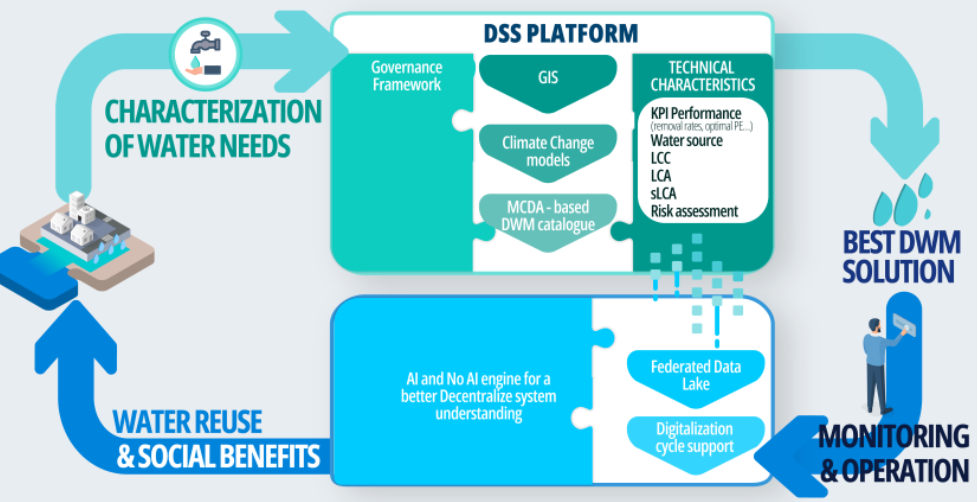
4. Build an AI-enabled Decision Support System (DSS) integrating a DWM catalogue, GIS tools, and climate change models for better water management decision.
Our concept
WATERSENS develops a comprehensive framework for the selection, design, integration, and operation of DWM systems.
This framework is implemented in a Decision Support System (DSS) that combines 6 aspects:
A parametric catalogue of decentralised solutions
MCDA / cost-benefit models
GIS-based tools
Climate change projections
AI and machine learning analytics
Standardised monitoring protocols for water quality and emerging contaminants